Custom Pools, Patios & Hardscape Services in Moultrie, GA
Colquitt County has something most of South Georgia does not, which is slope. Moultrie sits well above Valdosta in elevation and the land moves, so backyards here need walls, terraces and level surfaces before a pool can go anywhere.
- Building in Moultrie and Colquitt County since 1972
- About 50 miles northwest of Valdosta on GA 133, roughly an hour
- Retaining walls, terracing and grade work handled in house
- Hardscape materials matched to Moultrie’s older brick architecture
- Licensed and insured swimming pool contractor
Pools, Patios and Hardscape for Moultrie Homes
We have been making the drive up GA 133 for more than fifty years, and Moultrie work has always looked different from what we build closer to home. Our projects run through the older residential streets south and east of the courthouse square, along the Tallokas Road corridor, across newer subdivisions on the north side of town, and out to the smaller communities at Norman Park and Doerun.
Two things shape almost every job here. The land has grade, so structure comes before surface on a large share of properties, and a level patio often has to be cut and retained before it can exist at all. And the houses are older and largely brick, which means new hardscape either matches the architecture or fights it. Because we build the walls, the patios and the pool ourselves, those decisions get made together rather than by three separate contractors working from three different plans.
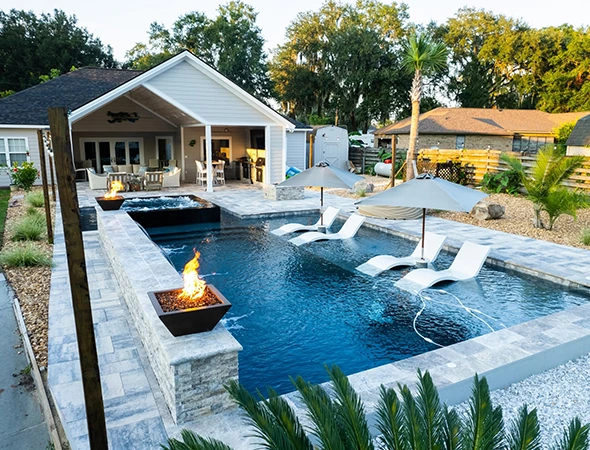
Our Services
Gunite, fiberglass and vinyl liner pools built into sloped Colquitt County lots, which usually means cut and fill work and a wall to hold the high side. We allow for the harder digging that Tifton upland soils produce at depth.
On a terraced yard a spa can sit at the upper level and spill down toward the pool, which turns a grade problem into the best feature on the property. Spillover and standalone builds both work here.
Terraced planting beds are what soften a walled yard and stop it reading as bare masonry. Colquitt County’s slightly cooler winters open up a marginally wider plant palette than we can rely on further south.
This is the backbone of most Moultrie projects. Retaining walls to hold grade, steps between levels, seat walls to define space and stone veneer chosen to sit comfortably against older brick homes rather than clash with them.
A natural grade change is the ideal setting for a waterfall, because the drop already exists and the feature reads as part of the landscape instead of a mound built on flat ground.
Moultrie has plenty of pools dating back decades that are on their second or third liner. We measure, order and install for pools we built and pools built by companies long gone.
Kitchen islands on a terrace need the retaining structure sorted first, since the wall carries the level the kitchen sits on. Masonry construction, outdoor rated appliances and utilities run properly.
Level changes are a genuine safety issue after dark and Moultrie yards have plenty of them. Step and wall lighting handles that, while grazing light across brick and stone shows off the texture these older properties already have.
A fire pit set into a lower terrace with seat walls around it makes use of ground that a slope would otherwise waste. Wood burning and gas builds both work, with placement checked against clearance and smoke drift.
Sloped lots need patios that are cut and leveled properly rather than poured to follow the grade. We build them to sit true, drain correctly, and connect to the house and the pool at sensible transitions.
Clay brick and warm toned pavers sit naturally against Moultrie’s older architecture, while light travertine keeps the surface comfortable barefoot through a Colquitt County July.
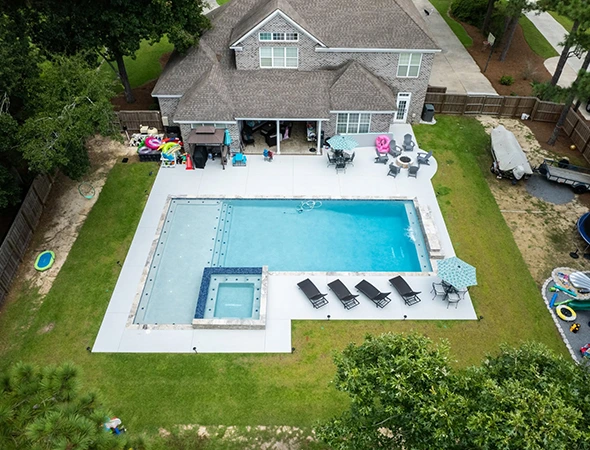
What Makes Colquitt County Ground Different to Build On?
Two things, and both show up during excavation. Moultrie sits around 340 feet above sea level against Valdosta’s roughly 200, and Colquitt County genuinely rolls in a way the flat lower counties do not. That grade change is why so many Moultrie projects start with a retaining wall or a terrace rather than a pool. Level usable ground has to be created before anything gets built on it. The second is the soil itself.
Colquitt County sits on Tifton series upland soils, which carry a plinthite horizon at depth, an iron rich hardpan layer that is considerably tougher to dig than the sandy loam above it. It slows excavation, it can surprise a contractor working from a standard quote, and it also affects drainage because water perches on top of it. We plan the dig around what is actually down there.
What Do Colquitt County's Numbers Say About Building Here?
They describe the largest market in our service area outside Valdosta. Colquitt County counted roughly 45,600 residents at the 2020 census, with Moultrie holding around 14,000 of them as the county seat. That makes Moultrie several times the size of Hahira, Lakeland or Nashville, with a correspondingly deeper stock of established homes and mature yards ready for renovation rather than new construction.
The county is one of Georgia’s leading agricultural producers, and Moultrie hosts the Sunbelt Agricultural Exposition each October, the largest farm show in North America, which brings tens of thousands of visitors into town. On climate, Colquitt County sits in USDA zone 8b like the rest of our territory, though the higher elevation means slightly cooler nights than Valdosta, which shows up at the very start and end of swim season more than in midsummer.
What Other Areas Do We Cover?
Moultrie sits at the northwestern reach of our territory, roughly 50 miles from our Valdosta base. Working back toward home we cover Tifton in Tift County to the northeast, Nashville in Berrien County, Lakeland in Lanier County, and Hahira and Valdosta in Lowndes County. Because Moultrie is at the outer edge of that radius, we schedule projects here in continuous blocks rather than scattered days, which keeps the work moving and the crew on site. Norman Park, Doerun and the surrounding Colquitt County communities are all within our normal working range.
How Much Grade Can a Moultrie Backyard Take?
Most Moultrie lots have some fall across them, and how much of it decides the whole approach. Under a foot is a regrade. Over five feet is an engineered wall with geogrid. This is roughly how we scope it before anything gets designed.
| Grade change across the yard | Usual approach | Permit likely | What you gain |
|---|---|---|---|
| Under 1 foot | Regrade and level the surface | No | A simple flat patio or deck area |
| 1 to 3 feet | Single low wall with a step | Rarely | Two defined levels, seat wall seating |
| 3 to 5 feet | Terracing with steps between tiers | Sometimes | Separate zones for pool, dining and fire |
| Over 5 feet | Engineered wall with geogrid | Yes, usually | Full usable level where none existed |
FAQs
Tifton series soils across this area carry a plinthite layer at depth, which is a dense iron rich hardpan considerably harder to cut than the sandy loam sitting above it. Where it occurs shallow, digging slows down and equipment works harder. It also perches water on top of it, which affects drainage design. We check depth to that layer during the site evaluation so the quote reflects the actual ground rather than an assumption.
By starting with the house rather than a catalog. We look at the brick color range, the mortar tone and the scale of the existing masonry, then select paver and veneer materials that sit in the same family without trying to copy it exactly. An exact match usually looks worse than a deliberate complement, because new brick never weathers the same way. Mortar color is the detail that does most of the work and the one most often ignored.
Properties within designated historic districts can be subject to local review before exterior alterations, and requirements vary by what is visible from the street. Backyard pools and hardscape are often less scrutinized than street facing changes, but fencing, which is required by pool barrier code, may be. Check with the City of Moultrie before finalizing a design if your property carries a historic designation.
Yes, and some of the best pools we build sit on sloped ground. The approach is cut and fill, excavating into the high side and retaining it with a wall while building up the low side to create a level pool area. It costs more than building on flat ground because of the structural work involved, and it delivers something a flat lot cannot, which is a pool with a raised edge, a natural spot for a custom spa spilling down from the upper terrace, and defined levels around it.
Slightly, at the margins. Sitting around 340 feet means marginally cooler overnight temperatures than Valdosta, which mostly affects how quickly a pool warms in early spring and how long it stays comfortable into the fall. Midsummer is no different. If you want to extend the season at either end, a heater or a darker pool finish makes far more difference than the elevation does.
Contact Us
That awkward drop across the backyard is usually the reason nothing has been done with it. It is also the thing that makes a properly designed pool and terrace look better here than on flat ground.