Outdoor Lighting Installation in Valdosta, GA
Everything you spent money on outside disappears at seven in the evening unless something lights it. Done well, lighting is the only improvement that gives you back half the hours in the day.
- Installing outdoor lighting in Valdosta and Lowndes County since 1972
- Solid brass and copper fixtures, never aluminum
- Warm 2700K LED throughout for consistent color
- Transformers surge-protected against South Georgia lightning
- Every system aimed at night with the client present
What Is Outdoor Lighting Installation and How Can It Improve Your Landscape?
Outdoor lighting installation is the process of planning and placing lighting fixtures to highlight specific areas of a property’s landscape after dark. It can include pathway lights, accent lighting, pool lighting, deck lighting and fixtures that highlight trees, walls or architectural features. Good landscape lighting is not simply about making the entire yard bright. Proper spacing, fixture placement and a warm color temperature around 2700K can create comfortable illumination while maintaining depth and contrast.
Harbin’s Pools designs outdoor lighting as part of the larger landscape and outdoor living space. Because we also build pools, patios, kitchens and other outdoor features, lighting can be planned alongside the construction rather than added as an afterthought. Conduit can be positioned before surfaces are completed, while fixtures are placed around the property’s long-term landscape design. The result is lighting that improves visibility, highlights important features and makes the outdoor space more inviting at night.
Our Services
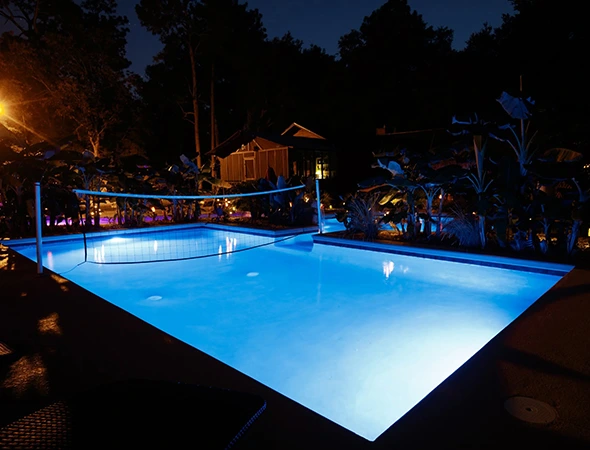
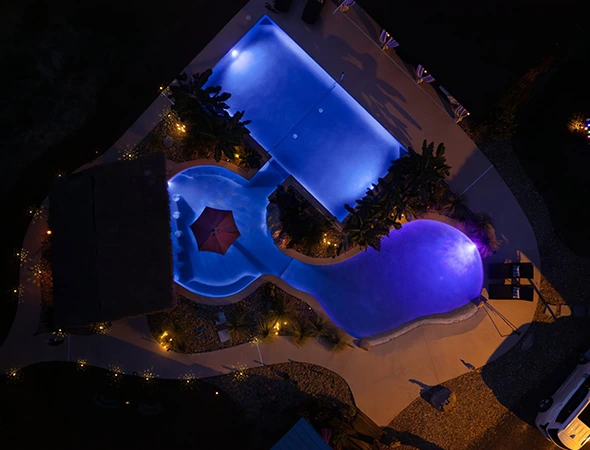
A lit pool is the centerpiece of a yard after dark, and an unlit one is a black hole. Niche lighting has to be planned during the build, not retrofitted through a finished shell.
Spas get used almost entirely at night. Low, soft light at the steps and surround is what makes getting in and out safe without killing the mood.
A mature live oak or a crape myrtle lit properly is the highest impact fixture in any yard. Placement accounts for how large the plant will eventually grow.
Light grazed across stone at a shallow angle throws every joint and texture into relief. It is the difference between a wall you notice and one that vanishes.
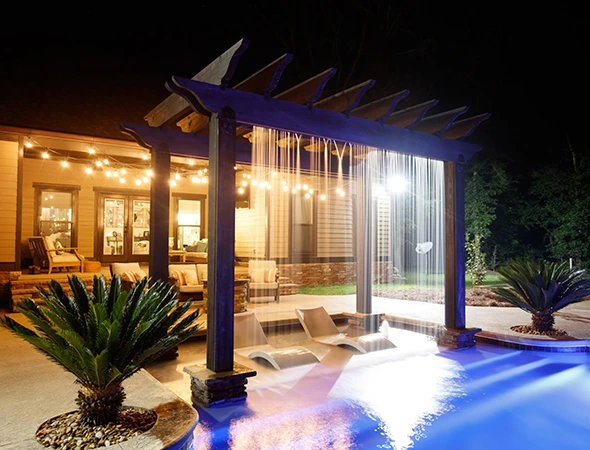
Water lit from behind and below looks entirely different from water lit from the front. Fixtures go in while the rock is being set.
Light niches and gaskets come out during a liner change anyway, which makes it the natural moment to replace an old incandescent fixture with LED.
Cooking needs genuine task light at the grill and the prep counter. That is a brighter, more focused fixture than anything else on the property.
Low-voltage LED systems covering pool and water feature lighting, path and step safety lighting, tree and architectural uplighting, and the transformers and controls behind them.
Firelight handles atmosphere and does nothing for safety. Low level lighting on the surrounding paths and steps covers what the fire cannot.
Edges, level changes and steps all need marking after dark. Conduit is far cheaper to run before the surface goes down than after.
Recessed deck and step lights sit flush in the paver field. Sleeves and wire get placed during the deck build so nothing has to be lifted later.
What You Get With a Harbin's Lighting System
Solid brass and copper fixtures. Aluminum corrodes in our humidity and fails fast anywhere near a saltwater pool. Brass patinas and keeps working for decades.
Transformers loaded to 80 percent, not 100. We leave headroom on capacity so the system runs cool, lasts longer, and can take additional fixtures later without a full replacement.
Waterproof direct burial connections. Silicone-filled connectors rather than twist caps, because corroded connections in wet South Georgia ground are the most common reason systems go dark.
Surge protection at the transformer. Georgia sees some of the heaviest lightning activity in the country, and an unprotected transformer is the first thing to go in a storm.
Aimed at night, with you standing there. Every fixture gets adjusted after dark while you watch, because nobody can judge a beam angle at two in the afternoon.
Our Work Process
Step 1: Night Walkthrough
We come out after dark with portable fixtures and light things temporarily so you can see the effect before committing to anything.
Step 2: Wiring, Transformer and Fixtures
Cable is run at correct gauge on planned circuits, the transformer is sized and mounted, and fixtures are set and connected with waterproof joints.
Step 3: Night Aiming and Controls
We return after dark to aim every fixture, set the timer or app control, and adjust anything that reads differently than expected once it is all live.
Pool and Water Feature Lighting in Valdosta, GA
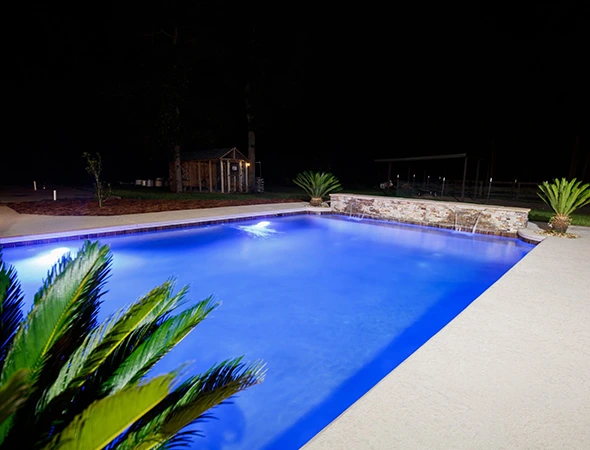
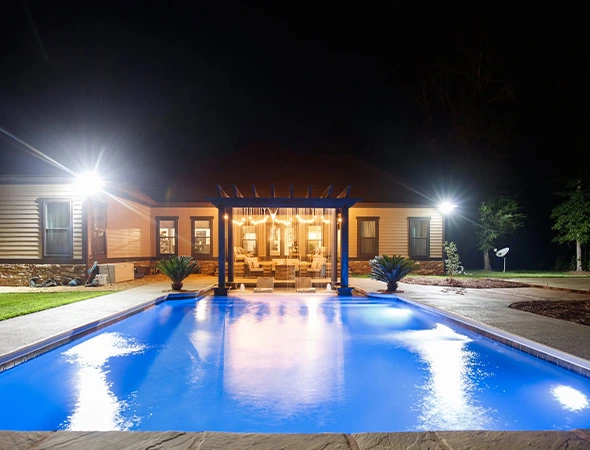
A lit pool changes a backyard more than any other single fixture. Modern LED niche lighting draws a fraction of the power the old incandescent units did, lasts far longer, and offers color-changing options that range from a subtle warm white through full color scenes tied to the rest of the system. Water features get treated separately, since a waterfall lit from behind the sheet glows in a way that front lighting never achieves, and submerged fixtures aimed up through moving water create movement across the surrounding stone.
All of it sits under electrical code, which is stricter around water than anywhere else on a property. Fixtures must be installed at the correct depth below the waterline, every metal component within five feet of the water has to be bonded, and circuits require GFCI protection. This is the part of a lighting system where we will not take shortcuts and where DIY work worries us most.
Path, Step and Safety Lighting in Valdosta, GA
The purpose of path lighting is to light the ground, not to be looked at. A well-placed path fixture is shielded so the lamp itself is never visible from standing height, casting a soft pool of light onto the surface while the fixture disappears. The most common mistake is spacing them evenly down both sides of a walk like runway markers, which looks institutional and wastes fixtures.
Staggering them and lighting only what needs lighting reads far better. Steps and grade changes are the genuine safety application, since a level change that is invisible at night is where people fall. Recessed step lights set into risers or seat walls handle that without glare. Around a pool it matters more again, because everyone walking that surface is barefoot, often wet, and frequently carrying something.
Landscape Uplighting and Moonlighting in Valdosta, GA
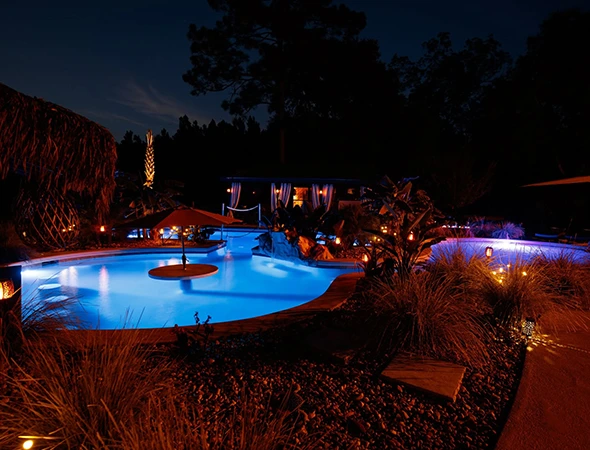
This is where lighting stops being functional and starts being the reason people sit outside. Uplighting places a narrow-beam fixture at the base of a tree, aimed up the trunk into the canopy, which turns a mature live oak into the dominant feature of a property after dark. Moonlighting does the opposite, mounting fixtures high in the branches and aiming down so light filters through the leaves and throws moving shadows across the ground below.
Valdosta’s live oaks are close to ideal for it, since the broad horizontal branching and dense canopy produce exactly the dappled effect the technique is named for. Grazing works the same principle against hardscape, placing a fixture close to a stone or brick face so light skims across it and every irregularity casts its own small shadow. Fixture placement accounts for eventual mature size, because a light aimed perfectly at a young tree is aimed at nothing in five years. On new planting and beds we set the fixture for the tree it will become rather than the one standing there.
Low Voltage Transformers, Wiring and Controls in Valdosta, GA
Almost every residential landscape system runs at 12 volts through a transformer, which is safer to work around, simpler to bury, and easier to extend than line voltage. The engineering that matters is voltage drop. Electricity loses pressure over distance, so fixtures at the far end of a long run go dim and yellow while the ones nearest the transformer burn bright, and that imbalance is the most common complaint we get called out to fix on systems installed by others.
The solutions are heavier gauge cable, hub wiring that feeds groups from a central point rather than daisy-chaining everything in a line, and multi-tap transformers that let us compensate on longer circuits. Sizing matters too, with total load kept to around eighty percent of rated capacity. Controls run from a simple astronomical timer that tracks sunset through the year up to app based systems with zones and scenes.
Lighting Techniques and What They Do
| Technique | What it does | Best for | Fixture used |
|---|---|---|---|
| Uplighting | Throws light up a vertical surface | Tree trunks, columns, facades | Narrow spot at ground level |
| Moonlighting | Casts dappled light down through branches | Mature live oaks over seating | Downlight mounted high in tree |
| Grazing | Skims a surface to reveal texture | Stone walls, brick, veneer | Spot placed close to the face |
| Path lighting | Pools light on the walking surface | Walkways, drives, garden routes | Shielded downward path fixture |
FAQs
2700K warm white for almost everything. It renders brick, stone, bark and foliage naturally and feels like firelight rather than fluorescent. 3000K is acceptable for modern architecture but is the practical ceiling, and anything cooler reads harsh and commercial in a residential yard. The bigger rule is consistency, since mixing color temperatures across one property looks obviously wrong even to people who could not name why.
Voltage drop. Power loses strength over the length of the cable, so fixtures furthest from the transformer receive less voltage and produce a dimmer, more yellow light than the ones nearest it. Undersized wire makes it dramatically worse, and daisy chaining every fixture in one long line guarantees it. It is corrected with heavier gauge cable, hub wiring that feeds groups from central points, and multi tap transformers that send higher voltage down longer circuits.
Usually yes, and it is one of the better value upgrades available to an older pool. LED replacement units fit standard niches, draw a small fraction of the power an old incandescent lamp consumed, last far longer and offer color options that were never available before. The existing niche, conduit and bonding need inspecting first, since older installations sometimes have deteriorated wiring or bonding that has to be corrected. Replacing the liner is the ideal moment to do it, because the niche is already accessible.
Electrical code sets specific minimum distances for receptacles from the water’s edge, requires GFCI protection on circuits serving pool equipment and lighting, and sets minimum overhead clearances for any fixture positioned above the water. Every metal component within five feet of the pool also has to be bonded into the equipotential grid. These rules exist because water and electricity together are unforgiving, and they are enforced at inspection. We design the layout against current code rather than guessing at clearances.
Not if it is aimed properly. Light trespass comes from fixtures with visible lamps, beams aimed above the horizontal, and floodlights pointed at boundaries. Shielded fixtures, correct beam spreads, and careful aiming keep light on the surface it is meant for and off everything else. Uplighting into a tree canopy should be aimed so the foliage catches the beam rather than letting it escape into the sky. Aiming at night is exactly when this gets checked and corrected.
Contact Us
We will come out one evening with fixtures and light things temporarily so you can see exactly what the finished system will look like before spending anything.
About Us
Harbin’s Pools has been installing outdoor lighting across Valdosta and South Georgia since 1972. We build low-voltage LED systems in solid brass and copper, covering pool and water feature lighting, path and step safety, and landscape uplighting, as a licensed and insured outdoor living contractor. Every system gets aimed after dark, because that is the only time anyone can actually judge it.