Custom Fire Pit Installation in Valdosta, GA
A fire pit turns a yard into a room. Everyone faces in, phones go away, and the backyard suddenly works from October through April instead of sitting empty. Harbin’s Pools has been building custom fire features across South Georgia since 1972.
- Building custom fire pits in Valdosta and Lowndes County since 1972
- Wood-burning, natural gas, propane, fire tables, and poolside fire bowls
- Steel insert rings and firebrick on every wood-burning build
- Heat-rated stone only, never river rock or standard pavers
- Licensed and insured outdoor living contractor
What Is Custom Fire Pit Installation and What Does It Include?
Custom fire pit installation is the process of designing and building a permanent fire feature around your outdoor space, rather than simply placing a prefabricated ring in the yard. It includes selecting suitable fire-resistant materials, preparing a stable base, installing the fire pit structure and providing proper drainage. For wood-burning designs, a steel insert and firebrick lining help protect the structure from repeated heat and cooling.
Harbin’s Pools designs custom fire pits to fit the size, layout and style of your Valdosta outdoor area. We can coordinate the fire pit with patios, seating areas, landscaping, hardscaping and outdoor lighting so everything works together. Proper foundation preparation, material selection and drainage help create a durable fire feature that is safe, functional and designed for regular outdoor use.
Our Services
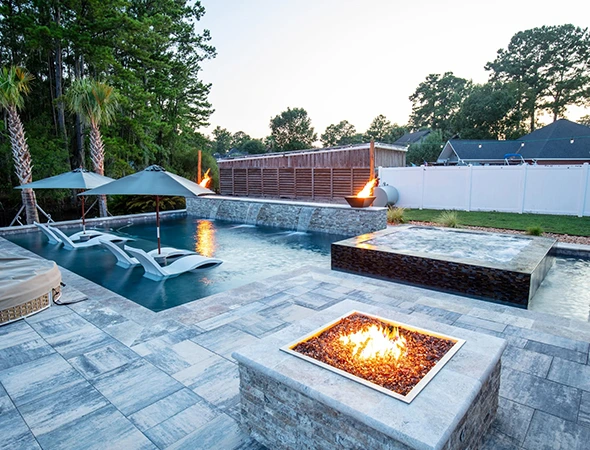
Fire at one end and water at the other gives a yard two gathering points for two different moods. It also keeps the pool area alive in the months nobody is swimming.
Spa and fire pit together are what make a South Georgia backyard usable in January. Set close enough that moving between the two does not mean a cold walk.
Nothing resinous, flammable or overhanging belongs near an open flame, and pine straw mulch definitely does not. Groundcover inside the seating circle switches to stone or gravel.
Seat walls are what turn a fire pit into a permanent gathering space instead of somewhere you drag chairs to. Both get laid out together.
Firelight on moving water is the reason to put them within sight of each other. Opposite sides of a seating area, not next to each other.
If the pool is out of action for a liner change, a fire feature keeps the yard in use while the work happens.
Cooking happens first and the fire happens after, so the two need to be close enough that the group moves together rather than splitting up.
Firelight is beautiful and useless for finding the steps. Low level path and step lighting handles safety while the fire handles atmosphere.
Custom Fire Pit Installation
Wood burning masonry pits, gas fire pits, fire tables and poolside fire bowls, built on proper base with steel inserts, drainage and heat rated materials.
The pit needs a level, non combustible surface underneath and around it, sized for a full circle of chairs with room to walk behind them.
Embers and heat land on whatever surrounds the pit. Individual units can be swapped if one gets scorched, which is not true of poured concrete.
What You Get With a Harbin's Fire Pit
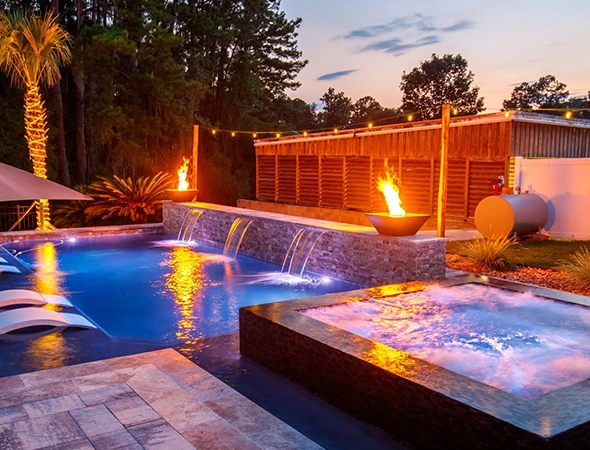
Steel insert ring and firebrick as standard. Every wood burning pit gets a proper liner between flame and masonry, which is what stops the structure from cracking from the inside out.
Heat-rated stone only. No river rock, no pea gravel, no standard pavers anywhere heat reaches. Trapped moisture in the wrong stone is a real hazard, not a theoretical one.
Drainage built into the base. The pit sheds water rather than holding it, which matters in a climate that delivers rain in volume and leaves fire pits sitting unused for weeks.
Gas shutoff placed at a safe distance. Key valves and propane enclosures are positioned and vented correctly, with enclosure ventilation at the base where heavier-than-air fuel actually collects.
The seating circle is sized before the pit is built. We set the diameter and the surrounding patio dimensions around how many people you want around it, so nobody ends up sitting in a walkway.
Our Work Process
Step 1: Placement and Wind Check
We look at clearance from the house, tree canopy overhead and the direction smoke will actually travel, then set the location and the seating radius.
Step 2: Base, Core and Burner
Compacted base goes in, then the structural core with a steel insert for wood or a burner pan and gas line for fuel, with drainage at every level.
Step 3: Veneer, Media and First Burn
Stone or brick facing goes on, media is set, then we light it with you present, check clearances and walk through operation and shutoff.
Wood Burning Fire Pit Construction in Valdosta, GA
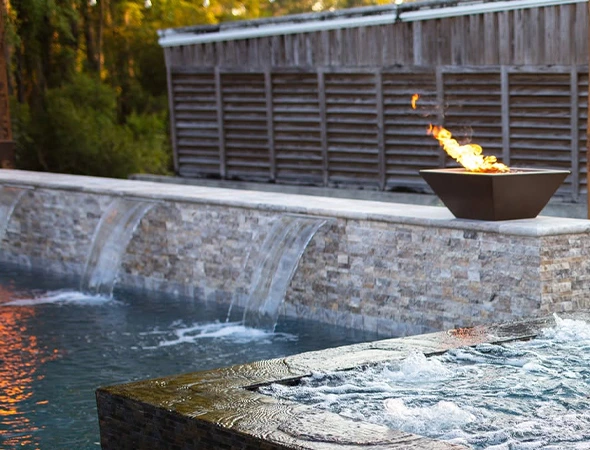
A wood fire is the one most people picture, and it is still the most requested build we do on larger lots. The construction is straightforward and unforgiving of shortcuts. We set a compacted base, build a structural core in block, line the interior with firebrick, and drop in a steel insert ring that takes the thermal cycling instead of the masonry. The interior floor is built to drain rather than pond, since an open pit collects every inch of rain that falls in it.
Typical finished height runs twelve to eighteen inches, which is low enough to see over while seated and high enough to contain a real fire. Wood burning needs the most clearance of any option, both horizontally from structures and vertically from tree canopy, which on established Valdosta properties with mature live oaks is usually the constraint that decides placement.
Gas Fire Pits and Fire Tables in Valdosta, GA
Gas has taken over for a reason. There is no wood to buy, split, store or haul, no smoke in anyone’s eyes, no ash to shovel out, and the fire is on in a second and off in a second. That convenience is what turns a fire feature from something used a few nights a year into something used most weeks through the cool season.
Construction centers on a burner pan sized correctly for the opening, with the right BTU output, correct air mixture and a media layer of lava rock or fire glass to diffuse the flame. Fire tables raise the whole thing to around table height so drinks and plates have somewhere to sit and the flame is at eye level from a normal chair. Natural gas suits in town properties with service available, while propane works anywhere provided the tank enclosure is ventilated at the base rather than the top. If an outdoor kitchen is anywhere in the plan, run both gas lines in the same trench while it is open, because the second one costs almost nothing at that point.
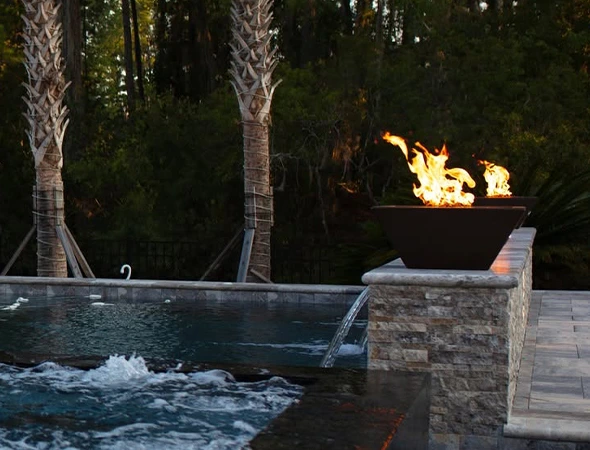
Poolside Fire Bowls and Fire Features in Valdosta, GA
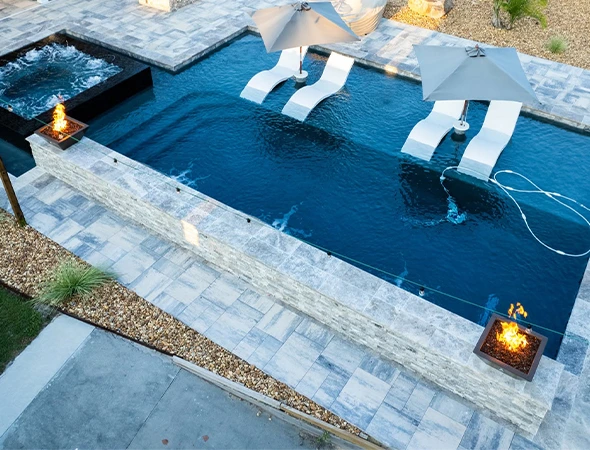
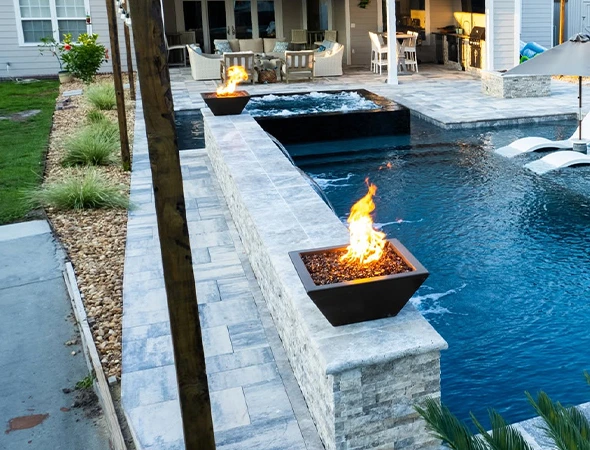
Fire against water is the most dramatic thing you can do in a backyard, and around a pool it takes a form all its own. Raised fire bowls set on columns at the corners of a pool or along a raised bond beam give you flame reflecting off the surface from every angle, and they read as architecture rather than as a piece of furniture. Fire and water bowls combine both, running a sheet of water off the same structure that carries the flame.
These are almost always gas, since ash and embers falling into a pool are not something anyone wants to skim. Gas lines and electrical for ignition have to be planned during the pool build or the decking work, because retrofitting means cutting into finished decking and coping. If a pool project is even a possibility down the line, running the stub now costs very little.
Fire Pit Placement, Clearances and Smoke Control in Valdosta, GA
Where a fire pit goes matters more than what it is made of. Clearance from the house, fences, sheds and anything combustible is the first constraint, and open wood burning requires considerably more separation than a contained gas flame. Overhead is where people get caught out, because a live oak or pine canopy sitting above a wood fire is a genuine hazard and shows up on plenty of Valdosta lots.
Then there is smoke, which follows prevailing wind and settles into low ground, so a pit placed in the wrong corner sends smoke straight into a screened porch or a neighbor’s yard every time it is lit. We check the natural airflow across the property before setting a position. Distance from seating gets planned too, generally around three to four feet of clear space between the pit edge and any chair, which puts the full circle at roughly twelve to fourteen feet across.
Wood, Natural Gas or Propane
| Wood Burning | Natural Gas | Propane | |
|---|---|---|---|
| Startup | Build and light a fire | Instant, key or switch | Instant, key or switch |
| Smoke and smell | Yes, the point for some | None | None |
| Fuel supply | Buy and store firewood | Unlimited from the line | Tank refills |
| Running cost | Cost of wood | Lowest ongoing | Higher per hour |
| Placement freedom | Needs the most clearance | Fixed to the gas line | Anywhere with tank access |
| Best suited to | Traditionalists and big lots | In town homes with gas service | Rural lots without gas service |
FAQs
Georgia distinguishes between burning yard debris, which generally requires a permit from the Georgia Forestry Commission, and a recreational fire in a contained pit or approved appliance, which typically does not. That said, local fire departments and municipalities can set their own rules on size, fuel and clearance, and counties may issue temporary burn bans during dry conditions. Never burn leaves, brush or construction debris in a recreational pit. Check with the City of Valdosta or Lowndes County fire officials for current local requirements.
No, and this is the most dangerous shortcut in the category. Porous stones like river rock, pea gravel and sandstone absorb water, and when that trapped moisture is heated rapidly it turns to steam with nowhere to escape, which can fracture the stone forcefully. Standard concrete pavers are not rated for direct heat either and will spall at the surface. Firebrick, heat rated block and a steel insert are what belong in contact with flame.
Usually wet or unseasoned wood, which spends its energy boiling off moisture instead of burning cleanly. Firewood needs six months to a year of drying, and in our humidity it should be stored off the ground and covered on top with the sides open. Poor airflow is the other cause, since a fire starved of oxygen smolders rather than burns. Softwoods like pine burn smoky and resinous, so hardwoods such as oak and hickory are the better choice here.
A standard twenty pound tank typically gives somewhere between four and ten hours depending on the burner size and whether you run it at full output. Larger burners in bigger pits consume noticeably faster, and running on a lower flame extends it considerably. Most clients who use their fire pit regularly move to a larger buried or screened tank so refills become an occasional job rather than a constant one. This is a big part of why natural gas wins where a line is available.
Wood burning, no. Open flame and flying embers under any roof structure is a fire risk and generally not permitted. Gas fire features can sometimes work under a high, well ventilated structure, but it depends entirely on ceiling height, clearance to combustible framing and airflow, and it requires checking against code rather than assuming. An open slatted pergola with substantial height above the flame is a different situation from a solid low roof. We assess it on site rather than giving a blanket answer.
Contact Us
Tell us how many people you want around it and whether you want to smell woodsmoke or just flip a switch. We will handle placement, clearances and the build.
About Us
Harbin’s Pools has been building custom fire pits and fire features across Valdosta and South Georgia since 1972. We construct wood burning pits with steel inserts and firebrick, gas pits and tables with correctly sized burners, and poolside fire bowls, all as a licensed and insured outdoor living contractor. Fifty years of masonry work in this climate is what keeps them intact through the heat cycles.