Residential Landscaping Services in Valdosta, GA
Valdosta is called the Azalea City for a reason. Things grow well here, but only the right things, and sandy, acidic soil punishes anyone planting from a generic catalog. Harbin’s Pools has been designing and installing residential landscapes across South Georgia since 1972.
- Landscaping Valdosta and Lowndes County properties since 1972
- Plant selection built for USDA zone 8b heat, humidity and sandy soil
- Soil tested before anything goes in the ground
- Full outdoor living contractor: planting, drainage, hardscape and pools
- Fifty years of watching which species actually survive here
What Is Residential Landscaping and How Is It Planned for Valdosta, GA?
Residential landscaping involves designing, installing and maintaining the living elements of a home’s outdoor space. It includes plant selection, lawn areas, trees, shrubs, soil preparation, grading and drainage based on the property’s conditions. South Georgia’s sandy loam and clay soils, acidic conditions, heavy rainfall and long periods of summer heat can affect how plants grow. Choosing species suited to the local environment is important for creating a landscape that stays healthy beyond the first season.
Harbin’s Pools has been designing and installing residential landscapes in Valdosta and surrounding South Georgia communities since 1972. We select plants based on local soil, sunlight, drainage and long-term performance rather than appearance alone. As an outdoor living contractor, we also coordinate planting with pools, patios, hardscapes, grading and drainage. This approach helps create a landscape where the living and structural elements work together without requiring major changes later.
Our Services
A pool build reshapes the yard and compacts the ground around it. Planning the planting at the same time means we restore grade properly and set beds where roots will not reach the shell.
Spas need screening more than pools do because they get used in bare feet after dark. Evergreen planting at seated eye level does more for privacy than a fence.
Landscape design, plant selection, sod, beds, mulch, drainage and grading for residential properties. Everything specified for zone 8b conditions and the soil on your particular lot.
Walls and steps create the planting pockets and grade changes that give a flat South Georgia lot some structure. Softening that stone with the right shrubs is what keeps it from reading as bare masonry.
Stone features look manufactured without planting tucked into and around them. We plant ferns, liriope and low evergreens at the base so the feature settles into the landscape.
Liner work needs equipment access across the yard. We schedule around beds and irrigation lines, then repair anything the route disturbs.
Heat, grease and foot traffic decide what can live near a kitchen. We use tough, heat tolerant species close in and save the delicate material for further out.
Uplighting a live oak or a crape myrtle is the highest impact lighting in most yards. We coordinate fixture placement with mature plant size so the effect still works in ten years.
Nothing flammable or resinous belongs within reach of a fire pit, and pine straw mulch definitely does not. We switch to stone or gravel groundcover inside the seating radius.
Patios need planting on at least two sides or they feel stranded in the middle of a lawn. Bed lines get drawn with the patio, not after it.
Root systems lift pavers. We keep trees a safe distance back and use root barriers where planting has to sit close to a paved surface.
What You Get With a Harbin's Landscape Install
Soil tested before we plant anything. We check pH and composition first, because most struggling South Georgia landscapes are a soil problem wearing a plant costume.
A plant list written for zone 8b. Species are chosen for our heat, humidity and sandy ground, not pulled from a national catalog that ignores both.
Poolside species screened for debris and roots. Anything within reach of water gets checked for leaf drop, berries, staining and root spread before it makes the plan.
Irrigation zoned by water need. Beds and turf run on separate zones, so shrubs are not drowning while the lawn is still thirsty.
Beds graded to shed water. In a climate that delivers rain in sudden volume, planting beds are shaped to drain rather than hold.
Our Work Process
Step 1: Site Walk and Soil Test
We look at sun exposure, drainage patterns, existing trees and how you use the yard, then test the soil so the plan starts from facts.
Step 2: Design and Plant Plan
You get a layout showing bed lines, species, mature sizes and turf areas, with a clear number attached before any work begins.
Step 3: Install and Establish
We prep soil, plant, sod, mulch and set irrigation, then walk you through watering during the establishment window that decides whether it all takes.
Landscape Design and Plant Selection in Valdosta, GA
Good landscape design in South Georgia starts by accepting the climate instead of fighting it. We build plant palettes around species with a long track record here: live oak, southern magnolia and crape myrtle for canopy, sasanqua camellia and Encore azalea for seasonal color, loropetalum, dwarf yaupon holly and Indian hawthorn for evergreen structure, and muhly grass or liriope for texture and edging.
Windmill and sabal palms hold up through our winters where more tropical species do not. We also plan for mature size rather than nursery size, which is the mistake we most often get called in to correct. A shrub planted eighteen inches off a foundation looks right for two years and becomes a problem for the next twenty. Layout accounts for what the plant will be, not what fits in the truck.
Poolside Planting and Privacy Screening in Valdosta, GA
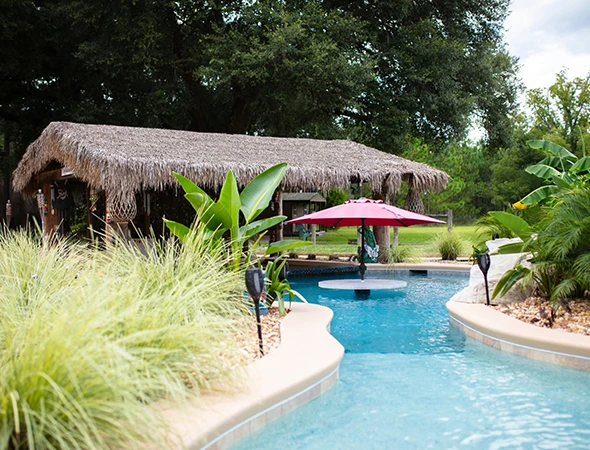
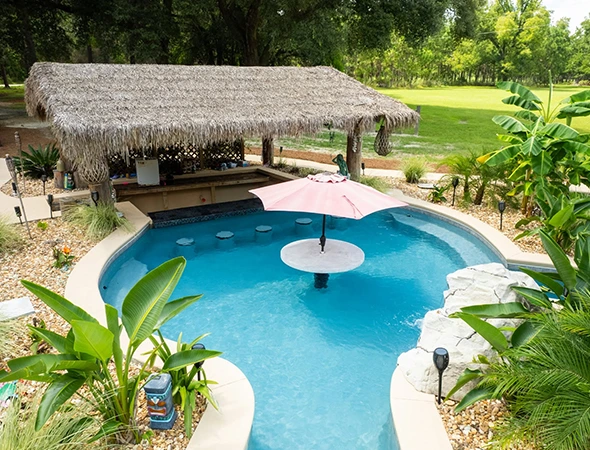
Planting near water follows different rules, and after fifty years of building pools we have seen every version of getting it wrong. Anything that drops heavy leaves, seed pods, berries or flowers ends up in the skimmer basket, and staining from fruit and sap is difficult to remove from plaster and pavers. Aggressive root systems are worse, since they lift the decking and can reach a shell or a plumbing line.
We keep those species well back and use clean evergreen material closer in, chosen for privacy at the height people actually sit and stand. Screening matters more again around a standalone spa, which gets used after dark and in bare feet. Splash out matters too. Chlorinated and salt treated water lands on nearby beds constantly, and salt systems in particular are hard on some ornamentals, so we specify tolerant species inside the splash zone. The result is screening that works without adding to your skimmer routine.
Sod Installation and Lawn Renovation in Valdosta, GA
Most Valdosta lawns are centipede, and for good reason. It suits our naturally acidic sandy soil, asks for very little fertilizer, and tolerates neglect better than anything else that grows here. It also has real limits: it handles foot traffic poorly, dislikes heavy feeding, and is prone to centipede decline when it is overfertilized or planted in compacted ground.
St.Augustine is the better choice under the live oak canopy that shades so many older properties in town, while Bermuda suits families with dogs and children running the same paths daily. Before laying anything, we address the reason the last lawn failed, whether that is shade, compaction, drainage or pH.
Sod goes down best from late spring through summer here, when soil is warm enough for fast rooting, which is the opposite of when we plant trees and shrubs.
Yard Drainage and Grading in Valdosta, GA
South Georgia does not get gentle rain. It gets two inches in forty minutes on a July afternoon, and a yard that cannot move that volume will hold it. Our sandy topsoil drains quickly until it hits the clay layer underneath, at which point water perches and sits, drowning roots and turning low spots into standing water for days. Valdosta’s flooding history is a reminder that this region moves a lot of water in a short time.
We correct it with proper grade away from the foundation, French drains where subsurface water needs a path, dry creek beds that handle volume and look intentional, retaining walls where a grade change needs holding, and swales that direct flow to somewhere it can safely go. Getting drainage right first is what protects everything planted afterward, which is why we address it before the first shrub goes in rather than after the second failure.
Choosing a Lawn Grass for South Georgia
| Centipede | St. Augustine | Bermuda | Zoysia | |
|---|---|---|---|---|
| Sun needs | Full sun to light shade | Best shade tolerance | Full sun only | Full sun to light shade |
| Foot traffic | Poor | Moderate | Excellent | Very good |
| Maintenance | Lowest | Moderate | Highest | Moderate |
| Soil pH | Prefers acidic, 5.0 to 6.0 | 6.0 to 7.0 | 6.0 to 7.0 | 6.0 to 6.5 |
| Watch for | Centipede decline | Chinch bugs, gray leaf spot | Constant mowing | Slow to fill in |
| Best suited to | Low input South Georgia lawns | Shaded yards under oaks | Kids, dogs, heavy use | Dense turf, higher budget |
FAQs
October through March for trees and shrubs, which is the reverse of what most national gardening advice says. Planting in the cool season lets roots establish through winter and early spring before summer heat arrives. A shrub planted in June spends its first months in survival mode and often never catches up. Sod is the exception and goes down best from late spring through summer when soil temperatures support fast rooting.
Georgia’s Water Stewardship Act permits outdoor landscape watering daily between 4pm and 10am statewide, with no assigned days. The restriction exists because midday watering loses a large share of the water to evaporation before roots ever see it. Newly installed sod and plants qualify for exemptions during establishment. Local utilities can add stricter rules during declared droughts, so check with the City of Valdosta if conditions tighten.
It depends entirely on what you are growing, which is why we test rather than guess. Our soils typically run acidic around pH 5.0 to 5.5, which centipede grass, azaleas, camellias and blueberries actually prefer. Bermuda, zoysia, vegetables and many ornamentals want closer to neutral and will need lime to get there. Applying lime blindly to a centipede lawn is a common and expensive way to make it worse.
All three are present across South Georgia and each attacks differently. Fire ants are a nuisance and a hazard around play areas and pool decks. Mole crickets tunnel under turf and are hardest on bermuda and centipede. Nematodes are the sneaky one, thriving in sandy soil and quietly weakening roots in ways that look like drought stress or nutrient deficiency, which is another reason we test before planting.
Remove them, and expect it to take more than one attempt. Chinese privet, kudzu, Chinese tallow and cogongrass are established invasives across South Georgia that outcompete anything you plant and spread from neighboring properties. Cutting alone regrows fast, so effective removal usually pairs mechanical clearing with correct timing and follow up. We handle clearing as part of a landscape renovation and design replacement planting to hold the ground.
Contact Us
Tell us what is failing, what you want it to look like, and how much time you want to spend maintaining it. We will walk the property, test the soil and put a real plan together.
About Us
Harbin’s Pools has designed and installed residential landscapes across Valdosta and South Georgia since 1972. We work in zone 8b conditions every day, choosing plants and turf that hold up to sandy acidic soil, long humid summers and sudden heavy rain. Fifty years in one climate is how we know what lasts here and what only looks good on paper.