Paver Deck Installation in Valdosta, GA
A pool deck gets judged barefoot and soaking wet. How hot it is at three in the afternoon, whether it grips when you climb out, and whether it still sits level in ten years.
Harbin’s Pools has been laying paver decks across South Georgia since 1972.
- Installing paver pool decks in Valdosta and Lowndes County since 1972
- Travertine, concrete, porcelain, and brick paver systems
- Decks sloped away from the pool as code requires
- Salt-safe materials and composite edge restraint on saltwater pools
- Licensed and insured outdoor living contractor
What Is Paver Pool Deck Installation and How Is It Designed for Pool Areas?
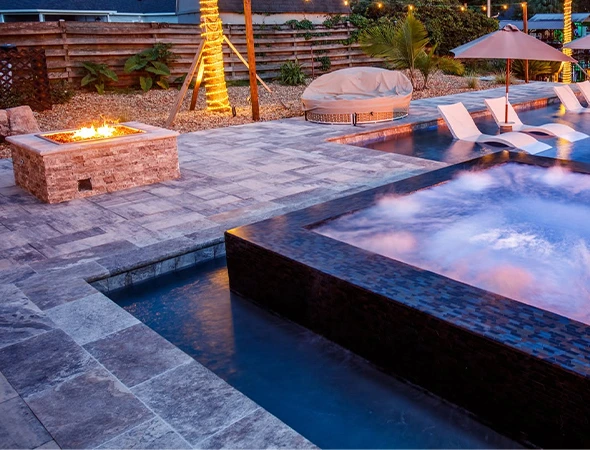
Paver pool deck installation involves preparing a stable base and installing a durable walking surface around an inground pool. The process includes excavation, layered base preparation, compaction, paver placement and careful detailing where the deck meets the pool coping. Material selection also matters in Valdosta, where summer temperatures can make dark surfaces extremely hot. Textured, slip-resistant pavers can provide better footing when the surface is wet.
Harbin’s Pools has been building pool decks in Valdosta since 1972, alongside the pools they surround. We understand how the deck and pool structure need to work together while allowing for normal movement. Proper preparation and detailing at the coping line help reduce shifting, dips and separation over time. We can also coordinate the deck’s color, pattern and layout with the pool, landscaping and other outdoor features for a cohesive finished space.
Our Services
The deck and the shell are one system at the coping line. Building both together means that joint is detailed correctly rather than patched afterward.
People step out of a spa in cool weather onto whatever surface is there. Texture and level around a spa matter more than anywhere else on the deck.
Beds sit right against paver edges, so root behavior and irrigation overspray both get planned. Roots lift pavers, and constant overspray stains them.
Raised deck areas need a wall to hold them, and that wall doubles as edge restraint. The two are built as one piece of structure.
The deck near a waterfall stays permanently wet from splash and spray. That zone gets specified for grip and drainage separately from the rest.
Coping and the bead track above the liner are exposed during a liner change, which makes it the right time to replace failing coping or lay a new deck.
Grease and spills land on the deck around a kitchen. Individual units can be lifted and swapped, which is not an option with poured concrete.
Deck lights, step lights and edge markers need conduit run beneath the pavers. Adding them later means lifting and resetting the field.
Heat and embers reach the surface immediately around a pit. Heat rated units go in that zone and can be replaced individually if scorched.
Where paver deck meets patio surface, the two have to match in level and drain the same direction so the transition reads as one continuous space.
Paver Deck Installation
Travertine, concrete, porcelain and brick paver decks with coping, edge restraint, proper slope and jointing, laid over new base or as an overlay on sound existing concrete.
What You Get With a Harbin's Paver Deck
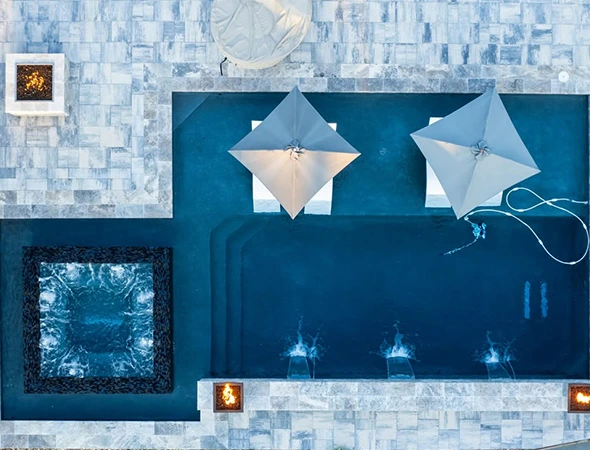
Sloped away from the pool. Every deck falls away from the water at proper pitch, which keeps runoff, dirt and lawn chemicals out of the pool and satisfies code at the same time.
Polymeric sand in every joint. Locks the field together, resists washout in heavy rain, and gives weeds and ants far less to work with than plain sand.
Composite edge restraint, not steel. Metal restraint corrodes fast around a saltwater pool. We use non corroding restraint so the edges hold for the life of the deck.
A real expansion joint at the coping. The deck and the pool structure move independently. Detailing that joint properly is what stops cracked coping and lifted units later.
Spare units left on site. We leave you matching pavers from the same production run, so a future repair blends instead of standing out in a slightly different shade.
Our Work Process
Step 1: Layout, Pattern and Levels
We confirm the deck footprint, choose the laying pattern, and set finished levels against door thresholds, coping height and drainage direction.
Step 2: Base, Bedding and Coping
Excavation, compacted aggregate in lifts, bedding layer, then coping set first because everything else lays to it.
Step 3: Field Laying, Cutting and Jointing
Units are laid, cut in at edges and curves, compacted, jointed with polymeric sand and locked in with edge restraint.
Pool Coping Installation in Valdosta, GA
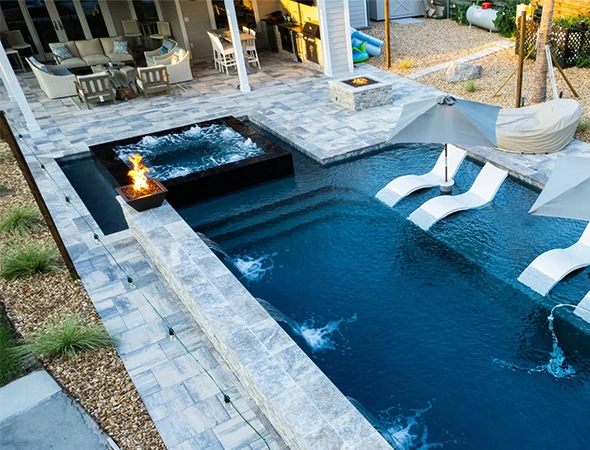
Coping is the edge that caps the pool wall and separates water from deck, and it does more work than anything else on the deck. It has to shed water outward away from the shell, give swimmers a secure handhold at the perimeter, and on a vinyl pool it carries the bead receiver track that holds the liner in place, which is why a liner change is the natural moment to replace failing coping.
Bullnose paver coping is the most common choice with a paver deck since the profile and material match, while natural stone coping in travertine or limestone gives a softer edge and stays cooler under hands and forearms.
Cantilevered concrete is still common on older Valdosta pools and can be replaced with paver coping during a renovation. The detail that matters most is the expansion joint between coping and deck, filled with flexible sealant so the two can move separately. Skip it, and the deck will eventually crack the coping.
Travertine and Cool Surface Paver Selection in Valdosta, GA
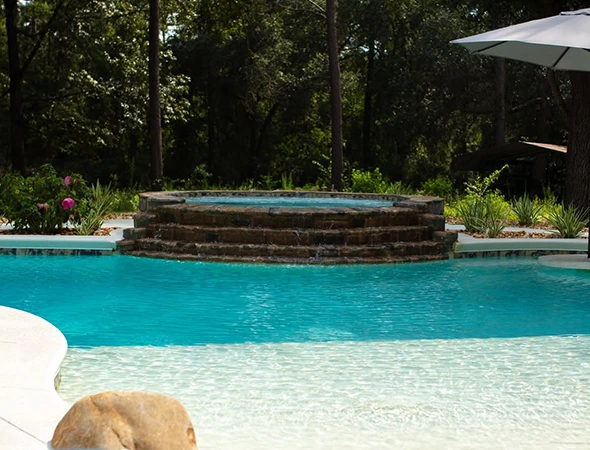
Travertine has become the default premium pool deck material across the South and the reason is simple physics. It is a light colored, naturally porous limestone, so it reflects rather than absorbs solar energy and runs meaningfully cooler than dark concrete under the same sun. That porosity also means it grips well when wet, which is exactly what you want on the surface people walk on climbing out of a pool, or out of a built-in spa on a cold night.
It is usually laid in a French pattern of four different unit sizes, which breaks up the field and hides small variations. Sealing is recommended here to resist staining and salt intrusion. If travertine is outside budget, the same principle applies to concrete pavers, where a light or mid tone selection will be dramatically more comfortable barefoot than a dark charcoal that looks striking in a photograph and burns your feet in July.
Paver Overlay on Existing Concrete Pool Decks in Valdosta, GA
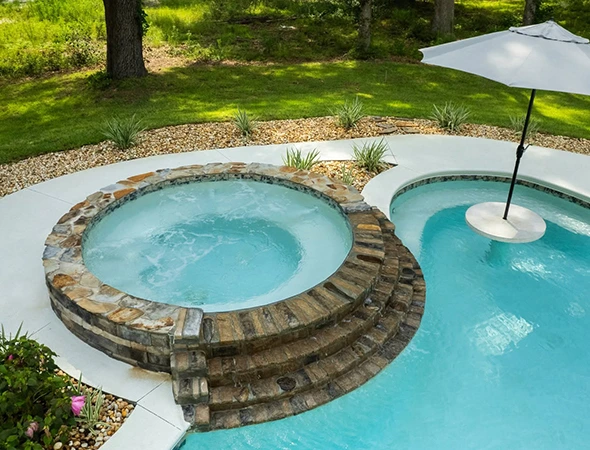
Plenty of Valdosta pools built in the seventies and eighties still sit inside a concrete deck that is cracked, stained and unevenly settled. Tearing it out is expensive, messy and slow. If the existing slab is structurally sound, meaning it has settled evenly and has no significant heaving or base failure, thin pavers can be laid directly over it instead.
It is faster, considerably cheaper than demolition and replacement, and produces a finished result indistinguishable from a new deck. Two things have to be checked first. Height is one, since an overlay adds a couple of inches and that has to work against door thresholds, existing coping and the top of the pool wall. Drainage is the other, because if the old deck slopes toward the pool the overlay is the moment to correct it rather than reproduce it.
Salt Resistance and Pool Deck Drainage in Valdosta, GA
Saltwater pools are common here and salt changes the material conversation. Salt attacks unsealed limestone and travertine over time, draws efflorescence out of concrete units, and corrodes metal edge restraint and fixings quickly. Sealing natural stone and using composite rather than steel restraint solves most of it. Drainage is the other half.
Code requires the deck to fall away from the pool so surface runoff cannot carry debris and lawn chemicals into the water, and in a climate that drops close to 48 inches of rain a year that slope has to actually work. Where the surrounding grade will not allow the deck to shed outward, we install strip drains along the low edge to collect and carry water away. Permeable paver systems on an open graded base are the other option, letting water pass straight through the surface instead of running across it.
Wood, Natural Gas or Propane
| Feature | Travertine | Concrete Paver | Porcelain Paver | Clay Brick |
|---|---|---|---|---|
| Heat Underfoot | Coolest | Hot in dark colors | Moderate | Moderate to hot |
| Wet Grip | Excellent, naturally porous | Good, depends on finish | Depends on rating | Good |
| Salt Tolerance | Good when sealed | Good, may effloresce | Excellent | Good |
| Color Fade | Minimal, natural stone | Fades slowly over years | None, color is fired in | Minimal |
| Relative Cost | Higher | Most economical | Highest | Middle |
| Upkeep | Seal periodically | Rinse and rejoint | Almost none | Rinse and rejoint |
FAQs
Less so than most alternatives, provided the right unit is specified. Travertine and textured concrete pavers grip well wet because the surface has microtexture and the joints between units break up any sliding surface. The risk comes from smooth, highly polished or heavily sealed products, and from film forming sealers applied without a non slip additive. Porcelain pavers should be checked for a slip rating before selection, since finishes vary enormously between products.
Efflorescence is a white powdery haze that appears on new concrete pavers as moisture carries natural salts to the surface. It is cosmetic, it is not a defect, and it is extremely common in the first year. In most cases it weathers away on its own within a season or two, and a specialized cleaner removes it faster if you would rather not wait. Natural stone such as travertine is far less prone to it than manufactured concrete units.
Far less than people expect when the joints are done properly. Polymeric sand hardens after activation and forms a firm joint that resists washout, root penetration and insect tunneling, unlike plain sand which lets everything through. Anything that does appear usually germinates in debris settled on top rather than growing up from below. Where bed lines run right to the deck edge we plan root behavior and irrigation overspray as well, because roots lift pavers and constant overspray stains them. Rinsing debris off periodically and rejointing every several years keeps it under control.
Longer, and it ages differently. Individual pavers are extremely durable and the field can be lifted and reset if the base ever settles, so the deck is repairable in a way a poured slab is not. Concrete will eventually crack and once it does the options are patching, which shows, or replacing the whole section. A well built paver deck can be maintained indefinitely by resetting sections and rejointing rather than being torn out.
Concrete pavers do not strictly require sealing, though it helps with stain resistance and color retention. Natural stone including travertine benefits significantly from it, particularly around a saltwater pool where sealing slows salt intrusion into the stone. Typical reapplication runs every three to five years depending on sun exposure and traffic. Use a breathable penetrating sealer rather than a glossy film forming product, which traps moisture and turns slick when wet.
Contact Us
Send us a photo of what you have now. We will tell you whether it needs replacing or whether an overlay will do the job for a fraction of the cost.
About Us
Harbin’s Pools has been installing paver pool decks across Valdosta and South Georgia since 1972. We lay travertine, concrete, porcelain and brick systems with proper base, coping, drainage and salt safe detailing as a licensed and insured outdoor living contractor. Because we build the pools underneath them, we know exactly how the deck and the shell need to meet.