Custom Pool Design & Landscape Services in Lakeland, GA
Lanier County is water country. Cypress ponds, blackwater and a water table that sits close to the surface for much of the year. Building a pool here is as much a groundwater problem as a construction one, and it is the single thing out of town contractors get wrong.
- Building pools and landscapes in Lakeland since 1972
- About 25 miles from our Valdosta base, roughly a 30 minute drive
- Experienced with dewatering, hydrostatic relief and saturated soils
- Plant selection matched to poorly drained Lanier County ground
- Licensed and insured swimming pool contractor
Custom Pools and Landscaping for Lakeland Properties
Fifty years of working in Lanier County has taught us where the ground is dependable and where it is not. We build across downtown Lakeland and the older Milltown streets, out toward Banks Lake on the west side of town, south through the Stockton community, and along the US 221 corridor running north toward Nashville.
Lakeland properties tend to combine generous lot sizes with genuinely difficult ground, which is a demanding combination. A yard can look perfectly buildable in October and be holding standing water in February. Because we handle both the pool and the landscape design here, we treat the whole property as one drainage system rather than digging a hole and hoping the rest sorts itself out. That approach is why our Lanier County pools stay where we put them.
Our Services
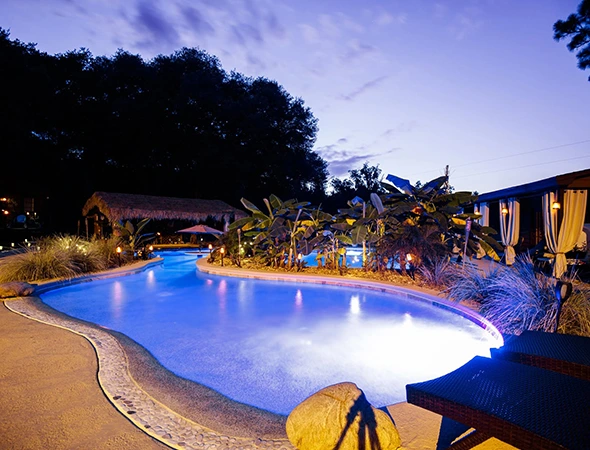
Gunite, fiberglass and vinyl liner shells, with the choice driven by how wet your specific site is rather than by preference alone. Every pool gets a working hydrostatic relief valve and a drainage plan sized for Lanier County ground conditions.
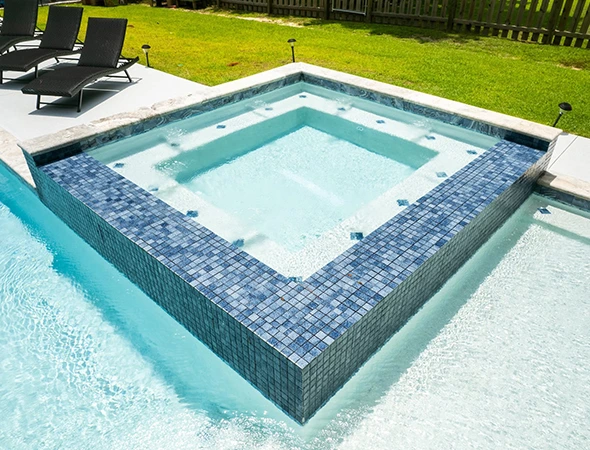
Spas need firm bearing and stable backfill, which takes extra planning on saturated sites. We build spillover spas into the pool structure and standalone spas set on properly prepared base rather than soft ground.
This is where local knowledge pays for itself. Wet areas of a Lanier County lot want bald cypress, river birch, wax myrtle and Virginia sweetspire, while the drier high ground supports the usual azalea and camellia palette. Planting the wrong list in the wrong zone kills it within two seasons.
Retaining walls and steps on soft, wet ground need deeper base preparation and far more attention to drainage than the same wall would on upland soil. Water pressure behind a wall is the main failure mode here.
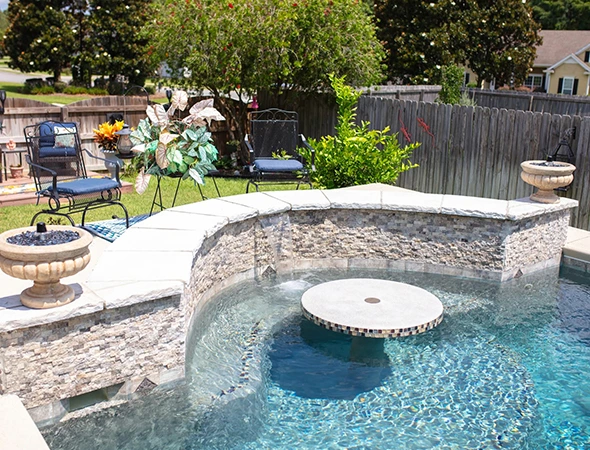
Heavy stone on saturated ground settles unless it sits on an engineered footing carried down to bearing soil. We build the structure for the conditions rather than setting boulders on backfill and hoping.
A liner change means draining the pool, and around Lakeland that is a decision to make carefully rather than casually. We time drains for dry conditions and manage hydrostatic relief throughout, because an empty pool in wet Lanier ground is genuinely at risk.
Masonry islands need stable footings, which on wet sites means preparing the base properly rather than pouring on whatever is there. Propane is the usual fuel out here since natural gas service is limited.
Buried cable and connections sit in ground that stays damp for months, so waterproof direct burial connectors are essential rather than optional. Low voltage lighting against a cypress backdrop is one of the better effects available in this county.
An open pit collects water, and around here it collects a lot of it. Drainage through the base matters more in Lanier County than almost anywhere we work, or the pit becomes a standing pond between uses.
Surface slope has to move water somewhere it can actually go, which on a flat wet lot takes planning rather than a default fall away from the house. Screened builds are popular here, and near the cypress ponds they are close to essential.
Permeable paver systems earn their keep on Lanier County sites, letting water pass through the surface instead of running across it. Where the deck cannot shed outward, strip drains carry it away.
Why Is Lakeland Harder to Build In Than Most of South Georgia?
Groundwater. The soils across much of Lanier County are Alapaha, Ocilla and Leefield series, which carry a seasonal high water table within a few feet of the surface through the wet months. Banks Lake itself is a Carolina bay, one of the elliptical depressions scattered across this landscape, and the same poorly drained conditions that created it exist on plenty of residential lots nearby. That matters in three ways.
Excavation frequently needs active dewatering before work can start, since a hole in saturated ground fills faster than it can be dug. An empty shell in wet ground is buoyant and will lift without correct hydrostatic relief. And backfill has to be specified and compacted properly, because saturated soil behaves nothing like the dry sand it looks like in summer. None of this stops a pool being built here. It simply has to be planned rather than discovered.
What Do Lanier County's Numbers Tell You About Building Here?
They tell you it is small, rural and defined by water. Lanier County recorded roughly 10,400 residents at the 2020 census across about 200 square miles, making it one of Georgia’s smallest counties by both measures, with Lakeland as the county seat holding around 3,300 of that total. Banks Lake National Wildlife Refuge covers several thousand acres immediately west of town, and the Alapaha River forms much of the county’s eastern edge.
That combination is why so much of the county’s land carries poorly drained soils and why FEMA mapped flood zones cover a meaningful share of parcels near the waterways. On climate, Lanier County sits in USDA zone 8b with close to a hundred days above 90 degrees a year and roughly 48 inches of annual rainfall, most of it arriving between June and September. That gives a long swim season and a wet building season at the same time. It is also why a permeable paver surround earns its keep on these lots, letting water pass through the deck instead of running across it.
Which Other Areas Do We Cover?
Lakeland sits roughly halfway between our Valdosta base and the northern end of our service area, so it is well within comfortable reach. Working outward, we also build in Hahira and Valdosta in Lowndes County, Nashville just north in Berrien County, Tifton further up in Tift County, and Moultrie to the northwest in Colquitt County. All of it falls inside about a 45 mile radius. Properties in the Stockton area and out toward the Alapaha are all within our normal working range.
Which Pool Shell Works Best on Wet Lanier County Ground?
All three can be built here, but they behave differently once groundwater is involved. The main variable is what happens when the pool is empty, because that is when a shell is vulnerable to being pushed up by the water underneath it. It is also why we time a new vinyl liner for dry conditions here and manage hydrostatic relief throughout, rather than draining whenever the calendar suits. Weight, wall construction and relief detailing all factor in.
| Gunite | Fiberglass | Vinyl Liner | |
|---|---|---|---|
| Buoyancy risk when empty | Lowest, heaviest shell | Highest, light one piece shell | Moderate |
| Dewatering during install | Usually needed on wet sites | Usually needed, critical for set | Usually needed |
| Hydrostatic relief | Essential | Essential and unforgiving | Essential |
| Backfill demands | Standard compacted backfill | Very specific, must be exact | Compacted around panels |
| Draining later | Possible with care and timing | Riskiest, rarely advisable | Needed for liner changes |
| Suitability on wet ground | Strongest option | Workable with strict detailing | Good, with drainage planned |
FAQs
Possibly, and it is worth checking before you spend anything. Jurisdictional wetlands fall under Section 404 of the Clean Water Act with oversight from the US Army Corps of Engineers, and disturbing them without authorization carries real penalties. Plenty of Lanier County parcels contain cypress ponds or low areas that may qualify. A delineation identifies exactly where the boundary sits, which usually just means positioning the pool elsewhere on the lot.
Usually yes, though it comes with conditions. Flood zone construction typically requires equipment to be elevated above the base flood elevation, since pumps, heaters and electrical panels sitting at grade will be destroyed by the first serious event. Local floodplain administration reviews the plans, and the pool itself is treated differently from habitable structures. Check your parcel’s flood zone designation early, because it affects the equipment pad location more than the pool position.
It can add cost, mainly through dewatering during excavation and more specific backfill requirements. The extra is usually a modest share of the total, and it is far cheaper than correcting a shell that shifted or lifted because nobody planned for the groundwater. What actually costs Lanier County homeowners money is hiring a builder who quotes the site as though it were dry upland ground and then discovers otherwise mid excavation.
Species that evolved for it. Bald cypress, river birch, wax myrtle, Virginia sweetspire, inkberry holly and Louisiana iris all tolerate periodically saturated soil that would kill an azalea within a season. The mistake we most often correct around Lakeland is a standard South Georgia plant list installed across a whole property with no distinction between the high ground and the low ground. Map the wet zones first, then plant to them.
Sometimes, though those trees are telling you something. Cypress, bay and tupelo are wetland indicator species, so their presence usually means the water table is high right there and the ground may be regulated. Their root systems also extend well beyond the canopy and do not tolerate having grade changed over them. We generally site pools away from these stands rather than clearing them, which keeps the project simpler and preserves the best feature on many Lanier County properties.
Contact Us
The ground here needs respect, not avoidance. Let us come out, check where your water table actually sits, and design a pool and landscape that work with the conditions instead of fighting them.