Hardscape Contractor in Valdosta, GA
Retaining walls, walkways, steps, seat walls and stone veneer built to hold their line for decades. In a climate that drops two inches of rain in an afternoon, drainage is what separates hardscape that lasts from hardscape that leans.
- Building hardscape in Valdosta and Lowndes County since 1972
- Licensed and insured outdoor living contractor
- Drainage engineered into every wall we build
- Base compacted in lifts and tested before anything is set
- Walls we built decades ago are still straight
What Is a Hardscape Contractor and What Can They Build?
A hardscape contractor designs and builds the permanent, non-living features of a landscape. This can include retaining walls, walkways, steps, seat walls, columns, patios and decorative stone or masonry work. These structures help define how people move through the yard, manage changes in elevation and create usable outdoor areas. Proper planning is important because hardscape features also need to work with grading, drainage, landscaping and the overall layout of the property.
Harbin’s Pools has been building hardscape features in Valdosta since 1972. We plan walls, paths and other structures alongside pools, planting areas and grading instead of treating them as separate projects. Our experience with South Georgia’s heat, humidity and rainfall helps us select materials suited to local conditions. The result is hardscape that supports the landscape, complements the home and creates a more functional outdoor living space.
Our Services
Sloped lots need walls before a pool can be dug, because the excavation depends on the grade being held. Getting the structural work in first is what makes the pool possible.
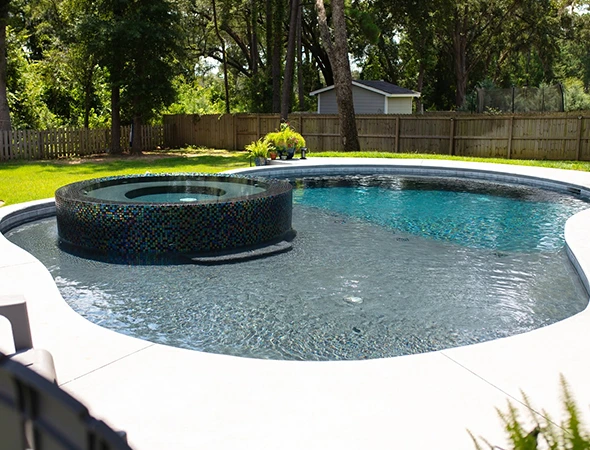
A raised spa sits inside a masonry surround that carries the shell and conceals the plumbing. That surround is hardscape doing structural work, not decoration.
Walls create the terraces and planting pockets that give a flat South Georgia lot dimension. Stone without planting reads as bare, and planting without structure has nowhere to sit.
Retaining walls, seat walls, steps, walkways, columns and stone veneer. Structural work built on compacted base with drainage designed in from the start.
Every waterfall needs a stable base and retained grade behind it. The stone you see is only possible because of the structure you do not.
Wall and coping condition gets checked whenever a liner comes out. It is the one moment the perimeter is fully exposed and repairs are simple.
Kitchen islands are masonry structures with utilities inside them. The block frame and veneer work are the same skills as any wall we build.
Wall lights, step lights and column fixtures need conduit run inside the masonry before it is capped. Retrofitting later means cutting stone.
A fire pit sits at the center of a seating area, and seat walls are what make that area usable. The two get designed as one piece.
Patios on any slope need a wall or a step transition to sit level. Structure comes first, surface comes second.
Edge restraint is what keeps a paved field from spreading, and on raised areas a wall does that job. Same base, same compaction standards.
What You Get With Harbin's Hardscape Work
Drainage behind every wall, not just the tall ones. Gravel chimney, filter fabric and a drain line as standard, because water pressure is what pushes South Georgia walls over.
Base compacted in lifts and checked. Aggregate goes down in layers and each one gets compacted. Dumping it all at once and rolling the top is why hardscape settles unevenly.
Edge restraint on every paved edge. Without it a paved field spreads outward year after year and the joints open. It costs little and it is not optional here.
Walls above four feet engineered, not eyeballed. Taller walls get proper design and geogrid reinforcement, along with the permit that usually comes with them.
Materials picked for heat and mildew. Dark stone gets punishing underfoot in a Valdosta July, and shaded surfaces grow algae in our humidity. Both get factored into the selection.
Our Work Process
Step 1: Grade and Drainage Assessment
We map how water currently moves across the property and where the grade needs to change, because that dictates what gets built and where.
Step 2: Excavation, Base and Compaction
We dig to depth, install and compact aggregate base in lifts, and set drainage before a single visible unit goes down.
Step 3: Setting, Jointing and Finishing
Units are set to line and level, joints filled and locked, caps adhered and edges restrained, then the site is cleaned and walked with you.
Retaining Wall Construction in Valdosta, GA
Most Valdosta lots are close to flat, but the ones that are not tend to sit near creek corridors or on the higher ground north of town, and those are where retaining walls earn their cost. A wall does two jobs: it holds soil at a grade change, and it creates usable level ground on both sides. The engineering that matters is behind the face.
We excavate to a proper leveling pad, build up on compacted aggregate, install a gravel drainage chimney with filter fabric and a perforated drain line, and backfill in compacted lifts. On anything above about four feet we bring in engineered design and geogrid reinforcement, which is also the threshold where most Georgia jurisdictions want a permit and stamped drawings.
Walkway and Pathway Installation in Valdosta, GA
A walkway is judged by whether people use it. Paths that ignore how someone actually crosses a yard get bypassed within a week, and the shortcut worn into the grass tells you the design was wrong. We set routes along the lines people already walk, at widths that suit the traffic, usually around four feet where two people need to pass and narrower for a garden path that is meant to slow you down.
Base construction is the same discipline as a wall, and the same one behind any paver decking, with excavation, compacted aggregate and proper edge restraint on both sides so the field cannot spread. Surface choice gets weighed against our climate, since dark units hold heat and heavily textured stone in shade will grow algae in South Georgia humidity. Slope is set to shed water sideways rather than run it toward the house or a low corner that already stays wet.
Outdoor Steps and Grade Transitions in Valdosta, GA
Steps are the most safety critical hardscape we build, and the most commonly built wrong. Riser and tread dimensions have to stay consistent through a whole flight, because the human body learns the rhythm on the first two steps and stops looking after that. A single riser that varies by even a small amount is where people fall. Outdoor steps run to shallower risers and deeper treads than interior stairs, which suits how people move outside, often carrying something and often in bare feet.
We build on compacted base with proper drainage so nothing shifts out of level over time, and we specify surfaces with grip that survives being wet. Where a grade change is gentle we would often rather build a graded ramp or a terraced transition than force steps into a slope that does not need them.
Seat Walls, Columns and Stone Veneer in Valdosta, GA
The finishing hardscape is what makes a yard feel designed rather than assembled. Seat walls are the highest value square footage in most backyards, since they give a gathering space permanent seating that never gets moved, blown over or put away for winter. We build them around eighteen inches high with a wide comfortable cap, positioned to define a space rather than just bound it.
Columns do the same job vertically, marking an entry, framing a view or carrying pergola posts and light fixtures. Stone veneer over a block core is how all of it gets tied back to the house, matching brick or stone on the home so the outdoor structure reads as part of the property instead of an addition. Any conduit for low voltage lighting or other utilities goes in before the veneer does, because cutting finished stone later is expensive and it always shows.
Retaining Wall Material Options
| Segmental Block | Natural Stone | Poured Concrete | Brick | |
|---|---|---|---|---|
| Look | Uniform, manufactured | Irregular, organic | Plain unless veneered | Traditional Southern |
| Relative cost | Most economical | Highest | Middle | Middle to high |
| Height capability | Tall with geogrid | Limited without backing | Tallest | Limited structurally |
| Repairability | Reset individual units | Reset individual stones | Difficult, patch shows | Moderate |
| Drainage | Built into system | Depends on build | Requires weeps or pipe | Requires weeps or pipe |
| Best suited to | Grade changes and terraces | Feature walls, waterfalls | Tall engineered walls | Matching historic homes |
FAQs
Generally yes once the wall exceeds four feet measured from the bottom of the footing to the top, and at that height most jurisdictions also require engineered drawings. Walls under that threshold are often exempt, though surcharge loads such as a driveway, pool or structure above the wall can trigger review at lower heights. Requirements differ between the City of Valdosta and Lowndes County, and again across Lanier, Berrien, Colquitt and Tift. We confirm with the specific authority before building rather than assuming.
Much shallower than in most of the country, because our frost line is only a few inches deep and frost heave is not the design driver it is up north. What governs depth here is bearing capacity and drainage instead, so we excavate to undisturbed soil and build up on compacted aggregate rather than digging to an arbitrary frost depth. This is one of the real cost advantages of building in this climate. It also means a contractor applying northern specs is often selling you depth you do not need.
Almost always a base problem rather than a paver problem. Insufficient aggregate depth, base that was not compacted in lifts, missing edge restraint or water undermining the base from below will all show up as dips, waves and open joints. The good news is that unit paving is repairable in a way poured concrete is not, since the affected section can be lifted, the base corrected and the same units reset. If a whole field is failing, the base needs redoing rather than patching.
It depends on the material and the exposure. Sealing helps with staining, joint sand stabilization and mildew resistance, which matters on shaded surfaces in South Georgia where algae takes hold quickly. It also darkens most stone and needs reapplying every few years, so it is a commitment rather than a one time job. Some natural stone breathes better unsealed, and sealing the wrong product can trap moisture and cause hazing.
They can, and live oaks are the usual culprit around here because their roots run wide and shallow. Roots do not push through properly compacted base easily, but they will lift edges and heave sections where they run directly beneath. We keep paved surfaces a sensible distance from mature trunks, install root barriers where proximity is unavoidable, and choose unit paving over poured concrete in those areas since individual pieces can be reset if movement happens.
Contact Us
Send us photos or let us walk the property. We will tell you what the site actually needs, whether that is an engineered wall or a simple regrade that costs a fraction as much.
About Us
Harbin’s Pools has been building hardscape across Valdosta and South Georgia since 1972. We construct retaining walls, walkways, steps, seat walls and stone veneer as a licensed and insured outdoor living contractor, with drainage and compacted base engineered into every job. Fifty years in this climate is why our walls are still standing straight.