Custom Spa Design & Installation in Valdosta, GA
A spa is the one part of the backyard that earns its keep in January. We design and build spillover spas tied into a pool, and standalone in-ground spas for yards without one. Harbin’s Pools has been building them across South Georgia since 1972.
- Building custom spas in Valdosta and Lowndes County since 1972
- Licensed and insured swimming pool contractor
- Spillover, raised, flush set, and standalone spas
- Anti-entrapment drains and bonded electrical on every build
- Spas we installed decades ago are still running on our service list
What is a Custom Spa and How It is Different From a Hot Tub?
A portable hot tub is an appliance. You buy it, set it on a pad, plug it in and eventually replace it. A custom spa is built into the ground as part of the structure, finished in the same material as your pool or deck, and engineered to last as long as the house.
Harbin’s Pools has been sizing these systems in South Georgia for over fifty years. We build spas as a custom pool builder rather than a dealer moving units, which means the shape, depth, seat height and jet layout are drawn for your body and your yard. We also design for how you will actually use it here, where mild winters make a spa a twelve month asset and a handful of hard freeze nights make proper protection non negotiable.
Our Services
When a spa and pool go in together, they share one heater, one pad and one set of controls. Building both at once costs considerably less than adding the second one later.
Spillover spas raised off a pool wall, flush set spas at deck level, and standalone in ground spas for yards without a pool. Shape, seating and jet placement are drawn to fit the people using it.
Planting around a spa is about privacy and screening at seated eye level. We also keep beds far enough back that mulch and leaf litter do not blow into eight hundred gallons of hot water.
Raised spas need a structural surround to carry the shell and hide the plumbing. Seat walls at the right height turn the area into a place people linger rather than just soak.
A spillover edge is already a water feature. Extending it into stone gives you sound and movement that carry into the evening, running off equipment the spa already has.
If your pool runs a vinyl liner, replacement is the natural moment to add a spa. The pool is already down and the equipment pad is already open.
Spa evenings are longer than pool afternoons, so people want food and drink within reach. A counter and fridge near the spa keeps everyone outside instead of tracking wet feet indoors.
Spas get used after dark far more than pools do. Step lights, low level path lighting and warm color temperature around the shell matter more than brightness.
Fire and hot water are the two things that make a South Georgia backyard work in December. Set close enough to move between, far enough that smoke does not sit over the spa.
The patio is where people stand while waiting their turn and where towels and drinks end up. We slope it to shed splash out and away from the spa surround.
Bare feet on wet pavers in cool weather is the detail nobody plans for. We specify texture and set the field so the walk from door to spa is short and level.
What You Get With a Harbin's Spa Build
A heater sized to the gallons, not to a catalog. We match BTU output to your actual water volume so the spa reaches temperature in under an hour, every time.
Anti entrapment drains, dual on every spa. Small volume means concentrated suction. Split intakes and compliant covers are standard here, not an upgrade.
Seat heights set to real bodies. Bench, lounger and footwell depths are drawn around who is using the spa, so jets hit the right place instead of your shoulder blades.
Insulated shell and a cover that seals. Most heat leaves through the surface. A properly fitted cover and insulated walls are what keep winter running costs sane.
Freeze protection wired in from day one. Controls sense low temperature and circulate automatically, so a February cold snap does not split a line.
Our Work Process
Step 1: Temperature, Seating and Use Planning
We ask who is using the spa, how often, and for what. Therapy, entertaining and quiet evenings all point to different sizes, seat layouts and jet counts.
Step 2: Shell, Plumbing and Jet Installation
The shell goes in with dedicated suction and return lines, then jets, blower and heater. Every line is pressure tested before it is covered.
Step 3: Heat Up Test and Controls Handoff
We run the spa from cold to full temperature, tune the jets, balance the water and show you how to work the controls before we leave.
Spillover Spa and Pool Combination Design in Valdosta, GA
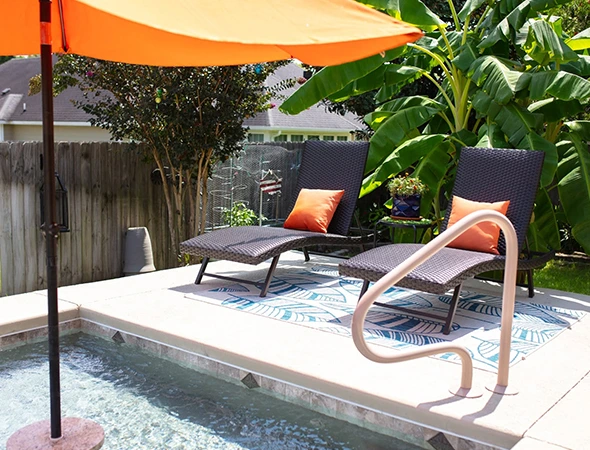
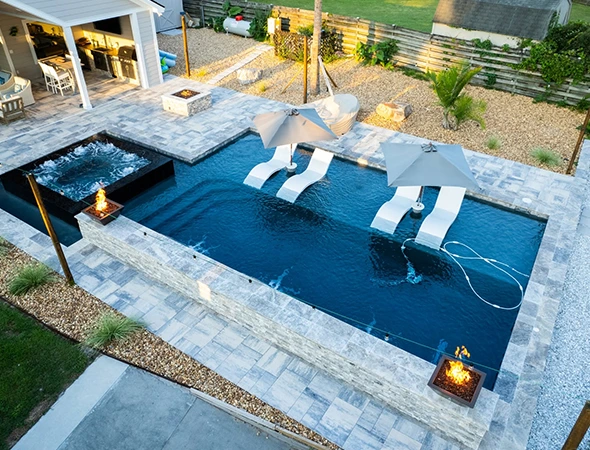
The most common spa we build sits raised twelve to eighteen inches above the pool waterline, with a weir edge that sends warm water sheeting into the pool below. It looks good and it sounds good, but the real benefit is mechanical. A combination spa shares one pump, filter, heater and equipment pad with the inground pool, with actuated valves that switch the system between pool mode and spa mode on command.
That means one set of equipment to buy, one to maintain and one to replace years from now. The tradeoff is that spillover returns warm water to the pool while the spa runs, so the design has to account for how much heat you are willing to give away. We set weir height and flow rate to balance the sound you want against the heat you keep. If you want more water sound than a weir edge alone gives, a rock waterfall can run off the same equipment rather than needing a pump of its own.
Standalone In Ground Spa Installation in Valdosta, GA
Plenty of Valdosta homeowners want the spa without the pool, either because the yard is small, the budget is focused, or nobody in the house is swimming laps. A standalone in ground spa is a full custom build with its own heater, filter, pump and controls, finished in plaster, pebble or tile and set flush with the deck or raised as a feature on a structural surround that carries the shell and hides the plumbing.
Because it stands alone, everything is sized purely for spa duty rather than compromised to serve a pool as well, which usually means faster heat up and stronger jets. It also opens up placement. A standalone spa can go close to the house, tucked into a courtyard, or screened in a corner, which is rarely possible with a pool. For most yards it is the shortest path from an empty slab to something you use four nights a week.
Hydrotherapy Jet Layout and Seating Design in Valdosta, GA
Jet count is the number people ask about and the least useful thing to judge a spa by. What matters is where the jets land, how they are grouped, and whether the pump can actually feed them all at pressure. We lay out seating first, then place jets against the specific areas people want worked on, usually lower back, shoulders, calves and feet. Bench seats sit around eighteen to twenty inches deep for upright soaking and conversation.
A lounger runs deeper and longer for one person to stretch out fully. Warm water at 100 to 104 degrees combined with buoyancy takes most of the load off joints, which is why so much of our spa work goes to people managing arthritis, old injuries or physically hard jobs. Get the geometry right and the spa does something for you. Get it wrong and it is a warm bathtub with noise.
Spa Heating, Insulation and Freeze Protection in Valdosta, GA
South Georgia winters are the reason to own a spa here, and the reason to build it correctly. Average January lows sit near forty degrees, which is comfortable soaking weather, but we still see a handful of nights each winter that drop into the twenties. Uninsulated plumbing and no freeze protection is how lines split. We insulate the shell walls, protect exposed runs, and set the controller to circulate automatically when temperature drops.
On the heating side, gas heaters recover fastest and suit people who want the spa hot on short notice, while heat pumps cost less to run for owners who keep the water hot continuously. The single biggest factor either way is the cover. A well fitted, sealed cover stops evaporation, and evaporation is where most of the heat and most of the money go.
Built In Spa or Portable Hot Tub
| Custom Built In Spa | Portable Hot Tub | |
|---|---|---|
| Installation | Excavated and built in place | Set on a pad or deck |
| Shape and size | Drawn to your yard and body | Fixed factory models |
| Finish | Matches pool and deck materials | Molded acrylic shell |
| Heat source | Gas heater or heat pump, sized to volume | Built in electric heater |
| Lifespan | Decades, resurfaced as needed | Roughly 10 to 20 years |
| Adds property value | Yes, permanent improvement | No, treated as personal property |
| Best suited to | Long term homes and pool owners | Renters and temporary setups |
FAQs
Usually yes, though it is more involved than building both together. The existing equipment pad has to have capacity for spa duty, actuated valves get added to switch modes, and new plumbing has to be trenched and tied in. Expect deck cutting where the lines run. We evaluate the current pad first and tell you honestly whether it can carry the spa or needs upgrading.
With a properly sized gas heater, roughly thirty to sixty minutes from ambient temperature to 102 degrees. Heat pumps are slower, often several hours, which is why they suit owners who keep the water hot all the time rather than heating on demand. Most of our clients preheat from a remote or phone app on the drive home. Undersized heaters are the number one complaint we hear about spas built by other companies.
104 degrees is the standard maximum for residential spas and is safe for healthy adults in sessions of about fifteen to twenty minutes. Lower the temperature for longer soaks or for children, and take breaks to cool off. People who are pregnant, on heart or blood pressure medication, or managing a cardiovascular condition should talk to a doctor before regular use. Alcohol and hot water are a bad combination at any temperature.
Georgia enforces the International Swimming Pool and Spa Code, which generally treats a spa the same as a pool for barrier purposes when it holds water deeper than twenty four inches. The common exception is a spa fitted with a lockable, rigid safety cover that meets the standard. Enforcement is local, so Lowndes County and the City of Valdosta may read it differently than Tift or Colquitt. We confirm the requirement with your jurisdiction during design.
Every three to four months for a spa in regular use, compared to years for a pool. The reason is dissolved solids. Small volume plus heavy bather load means minerals, oils and chemical byproducts build up quickly, and past a point no amount of dosing brings the water back. Draining and refilling a few hundred gallons is a short job, which is why we plan a drain point and easy hose access into every build.
Contact Us
Whether it spills into a pool you already own or stands on its own in an empty corner of the yard, we will walk the site and tell you what fits. No charge for the conversation and no pressure to build.
About Us
Harbin’s Pools has been designing and installing custom spas in Valdosta and across South Georgia since 1972. We build spillover, raised and standalone in ground spas as a licensed and insured swimming pool contractor, sizing the heating, jets and filtration around the way each client actually uses the water. A spa we build now is one we expect to still be servicing decades from now.